When was Edopia established?
Edopia was established in 2014. The school has now been serving families in Islamabad for over a decade.
Who founded Edopia?
Edopia was founded by Jaweria Sethi, a Harvard alumna who works closely with families and organisations rethinking education.
What kind of school is Edopia?
Edopia is a democratic school rooted in the wisdom of the Global South. Children do not come here only to study. They come to learn how to live with themselves and with others, to preserve their fitrah through conscious choices, and to understand their responsibility in the world. Community sits at the heart of the school, alongside the work of truly knowing oneself.
Is Edopia an international franchise?
Edopia is not an international franchise. It does not follow a pre-designed system. Its programme has been developed locally over a decade.
What makes Edopia different from a conventional school?
We do not treat school as academics alone. We give equal importance to learning, responsibility, community participation, social-emotional development, and the formation of a strong personal profile.
Are you only for families looking for an alternative school model?
This is an alternative school for families with progressive views on education. We are not here to convince you. We exist for families who already know the traditional system is not right for their child.
Do you take academics seriously?
Yes. The core subjects are taught seriously. Progress is tracked, and students are prepared for O Levels when they choose that route. This is only one third of what happens here. The remaining two thirds shape how a child thinks, works with others, and understands themselves and the world.
What philosophy guides Edopia?
Our work draws from Reggio Emilia, Project Zero at Harvard, and democratic schooling, held alongside our own long-term development as a school in Pakistan. Over time, this has led us back to a deeper question. Nothing meaningful can be built without returning to our own roots. An alternative school in a post-colonial context must ask who shaped the systems we inherited, and why.
What do you believe school is for?
We believe school is not only for academic study. It is also for building judgment, responsibility, community participation, and a strong inner life.
What does “democratic school” mean at Edopia?
It means children participate in real school life. They help shape rules, sit on committees, discuss problems, and take responsibility for the community they are part of.
What is the Three-Part Day?
Our day is structured around three parts: Academics, Community Engagement, and Concentrations.. Learn more about it by visiting the homepage.
What do you mean by “powerful personal profiles”?
We want children to leave school with more than grades. We want them to develop strong thinking, character, social-emotional awareness, self-knowledge, and the ability to make good choices.
Do you focus on character as much as academics?
Yes. We take academics seriously, but we do not believe academics alone are enough. Character is how a child thinks, chooses, and relates. It is their ability to act with integrity and take responsibility. Our framework holds this work with care, shaping it through daily practice.
What role does faith play in the school’s learning model?
This is not a religious school in the traditional sense. We do not prescribe a sect or school of thought, and we do not measure children by their religiosity. There is no expectation for families to practise in a particular way. But we are also not a value-neutral institution. At Edopia, our values are rooted in the ethical and spiritual wisdom of Islam, and our curriculum encompasses the cultural and historical wisdom of this region. We learn about the world, but we do not lose where we stand.
Do parents also engage with your learning philosophy?
This school works when there is alignment between home and school. Without that, the work begins to break. Parents are expected to take part in conversations around how children learn, how they are supported, and what matters in their growth. They are also expected to invest in their own learning and remain committed to growing alongside their children. What happens at home shapes what a child believes. For us to work together, we cannot be in constant friction. Differences are welcome when they lead to deeper understanding. Conflicting worldviews within the same space create chaos for the child.
What is the admission criteria for preschool?
For EY1 and EY2, the child should be able to hold a back-and-forth conversation. For EY3, the child should have phonemic awareness of all sounds and be ready to blend sounds into words.
What subjects do you teach?
We teach English, Mathematics, Science, Urdu, Social Emotional Learning, and Deen with care and rigour. Alongside this, students engage in school-wide courses and concentrations across six domains: fitness and wellness, financial literacy, arts and expression, research and reading, app and game development, and public speaking and diplomacy. They also work through long, transdisciplinary projects that draw from science, social sciences, literature, art, and history. So what subjects we teach is a limited way to understand what happens here.
How is learning structured in the early years?
Our early years are play-based and inquiry-led. Learn more by visiting the Pathways page.
What happens in Primary Years?
In Grades 1 to 3, all children move through a shared foundational programme that combines academic learning with community life and concentrations.
When do pathways begin?
Our two pathways begin from Grade 4 onward.
What is the Grade-Level Learning pathway?
This is our more structured, teacher-directed pathway. It is Cambridge-aligned and uses direct instruction.
What is the Self-Paced Learning pathway?
This pathway allows children to learn in multi-age groups and move forward at a pace that fits them, with teachers guiding rather than lecturing. The curriculum is Cambridge aligned.
Is one pathway considered better than the other?
No. We respect both pathways equally. The choice depends on what suits the child best.
Do both pathways lead to O Levels?
Yes. Both pathways can lead to O Levels for families who want that route.
What is the admission criteria for preschool?
For EY1 and EY2, the child should be able to hold a back-and-forth conversation. For EY3, the child should have phonemic awareness of all sounds and be ready to blend sounds into words.
What does a typical school day look like?
From Grade 1 onward, the day is built around three parts: Academics, Community Engagement, and Concentrations. This allows children to grow intellectually, socially, and personally. In the early years, the day looks different. It is shaped through play and inquiry, with long stretches of uninterrupted time for exploration. There are no school bells. Children move through the day with flow. They are not confined to desks, chairs, or fixed classrooms. Spaces shift, and the boundaries between indoors and outdoors remain open.
What are your school timings?
Preschool runs from 8:00 am to 12:00–1:00 pm. The rest of the school runs from 8:00 am to 2:00–2:30 pm. Optional after-school classes at Bani Gala run from 2:30 pm to 3:45 pm.
What happens during the community part of the day?
Community time includes morning gatherings, democratic assemblies, SEL, school-wide multi-age projects, committees, halaqas, reflection, prayer, and shared responsibilities within the school.
What are concentrations?
Concentrations are dedicated sessions where each child works with a coach on a chosen area of interest over a full term.
What are immersion weeks?
Immersion Weeks happen eight times a year. During those weeks, the normal timetable pauses and the school focuses deeply on one major project.
Do students spend time in silence?
Yes. Everyday silence for 20 mins is part of our daily rhythm.
Is prayer part of the school day?
Yes. Each day, the school gathers for Zuhr prayer in jamaat, with boys in front and girls behind. It is a shared moment that brings the community together, available for those who wish to join.
Do you offer after-school care?
No. We do not offer after-school care, though we do offer some optional after-school classes.
What is the admission criteria for preschool?
For EY1 and EY2, the child should be able to hold a back-and-forth conversation. For EY3, the child should have phonemic awareness of all sounds and be ready to blend sounds into words.
What is the admission fee?
Our one-time admission fee is PKR 120,000.
Is there an annual charge?
Yes. Our annual recurring charge is PKR 50,000.
What is the monthly tuition?
Monthly tuition ranges from PKR 53,000 to PKR 60,000 depending on grade level.
Are meals included in tuition?
No. Meals are charged separately.
Do you offer transport?
Yes. We offer transport through selected pick-up and drop-off points, charged separately.
Are after-school classes included?
No. Some after-school classes are charged separately.
Do children wear uniforms?
No. We do not have uniforms, but we do have dress guidelines.
Are any concessions available?
Families seeking financial aid fill a separate form. Seats are allocated based on availability, with placement determined by need and merit.
What is the admission criteria for preschool?
For EY1 and EY2, the child should be able to hold a back-and-forth conversation. For EY3, the child should have phonemic awareness of all sounds and be ready to blend sounds into words.
Where are you located?
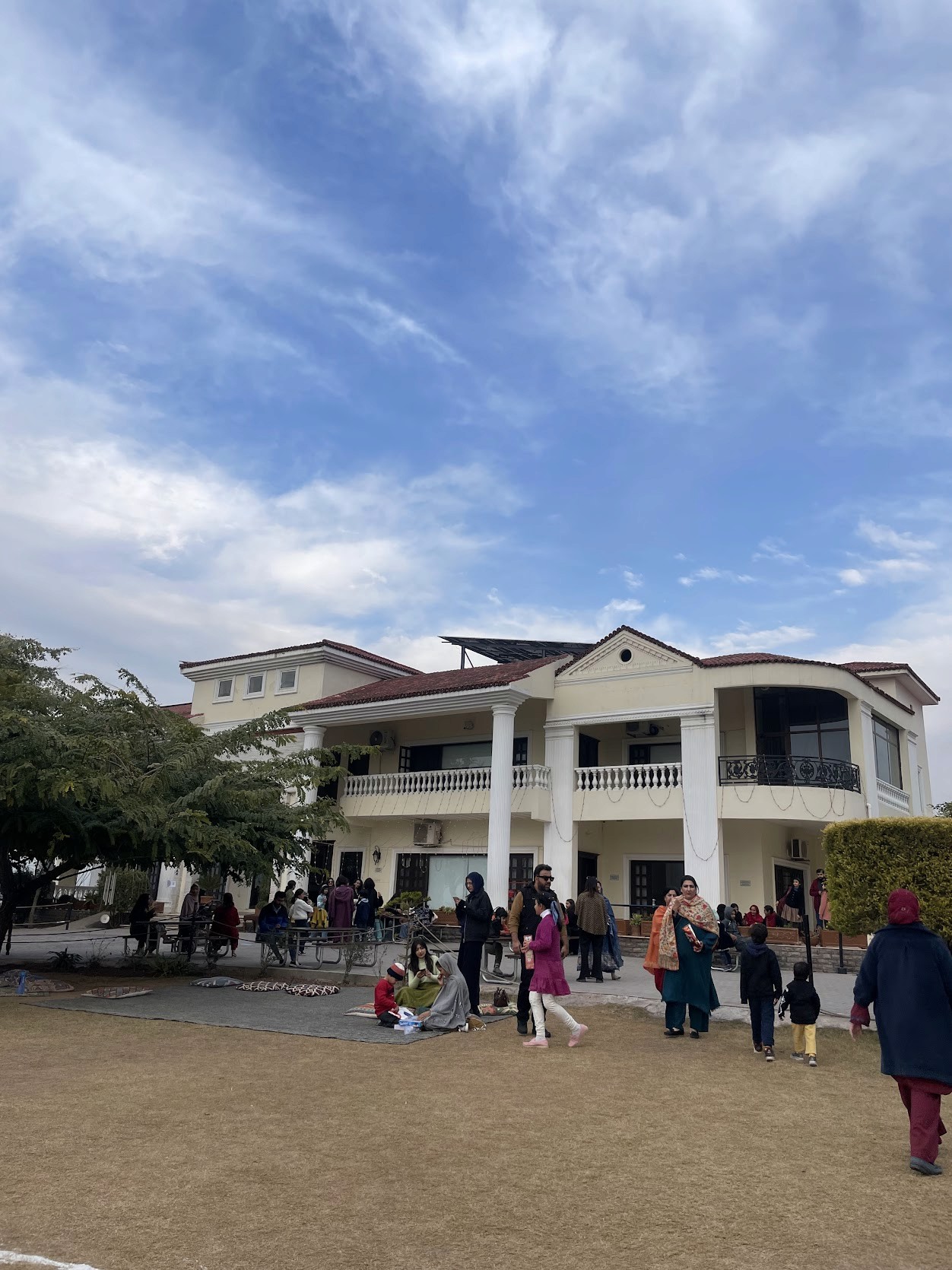
We have two campuses in Islamabad: Bani Gala and I-8.
What is the address of the Bani Gala campus?
Our Bani Gala campus is at House #1, Ghous Al Azam Road, Bani Gala, Islamabad.
What is the address of the I-8 campus?
Our I-8 campus is at 1-F Hajveri Market, I-8/2, Islamabad.
What age groups do you cater to?
We welcome children from ages 3 to 16.
Which campus serves older children?
Our Bani Gala campus offers classes from preschool through to O Levels.
Which campus serves younger children?
Both campuses offer preschool. The I-8 campus goes up to Grade 2, while the Bani Gala campus continues through to O Levels.
How do families choose the right campus?
Campus placement depends on the child’s age and grade level, along with the family’s ability to commute. I-8 is more central and is often preferred by families living nearby, especially those with younger children. Bani Gala works better for families with children across age groups and offers a richer community life. Many families have chosen to relocate, even from other cities and countries, to be closer to the campus.
Can I visit the campus before applying?
Visits are scheduled after you fill the waitlist form. The visit is part of the application process, and you can select your preferred date on the form.
What is the admission criteria for preschool?
For EY1 and EY2, the child should be able to hold a back-and-forth conversation. For EY3, the child should have phonemic awareness of all sounds and be ready to blend sounds into words.
What is the class size at Edopia?
Our average teacher-to-child ratio is 1:8.
How do you select teachers?
We look for relevant life experience, useful skills, openness to learning, and alignment with our model.
Do all teachers need formal teaching certifications?
Not always. We do not hire on certifications alone.
How are teachers trained?
Our teachers go through extensive summer training aligned with our learning framework, followed by regular coaching and feedback throughout the school year.
What kind of teacher fits Edopia well?
The people who fit best here are thoughtful, organized, willing to challenge convention, and ready to build trust with children.
How do you assess students?
We use assessment diagnostically, which means we use it to guide learning rather than rank children.
Do you publish rankings?
No. We do not use public ranking as part of our school culture.
Do you prepare students properly for formal exams?
Yes. We prepare students thoroughly for O Levels when they choose that path. Our students have been appearing for O Levels since 2018.
What is the admission criteria for preschool?
For EY1 and EY2, the child should be able to hold a back-and-forth conversation. For EY3, the child should have phonemic awareness of all sounds and be ready to blend sounds into words.
Do you accommodate children with special needs?
We do not have a dedicated inclusion unit, but we consider some cases individually based on the child’s needs and our capacity. For children with additional needs, we do not charge the school fee so that families can engage a qualified shadow teacher. As a small school with limited space, we are currently operating a waiting list for these seats.
How do you decide if you can support a child well?
We are able to support some children with additional learning needs through short-term 1:1 support, with the aim of helping them transition into the regular programme. This works best when there is consistent support in place outside of school as well. At this stage, our setting is not equipped to support children with more significant behavioural needs.
How do you help preschool children settle in?
The settling-in period runs from mid-July to mid-August. Children start with shorter hours and ease into a full day over time. Families are welcome to stay during this period to support the transition. If settling remains difficult after a couple of weeks, we may suggest trying again a little later. This transition can be significant. It is often not linear, and we understand that it can take time for both children and families. For this reason, timely completion of admissions for preschoolers is important, so they have the full settling period to feel secure and supported.
Can parents stay during the settling-in period?
Families are welcome to stay during the settling period (Mid July to Mid Aug). After the term begins, families can stay on campus from 8:00–9:00 am for settling. Over the first 2–3 days, parents are encouraged to gradually step out of the classroom. If a child is still unsettled, they may go home and return the next day within the same window for up to two weeks. After 9:00 am, we are not able to accommodate parent presence on campus.
What support exists for parents?
We offer parent learning spaces, community interactions, workshops, and conversations as part of our wider educational approach.
Do you help families think through parenting, not just school logistics?
Yes, we regularly host parenting workshops and discussion circles at the school as well.
Will my child be able to move to a traditional school later?
In many cases, children transition well academically, especially after Grade 3. The larger adjustment is often social and emotional.
How do you think about support overall?
We see support as something built through adult attention, community structures, and a strong partnership with families. It works when both sides are aligned. The school holds parts of your child’s life, but not all of it. A large part of what shapes a child happens at home. Questions like: Why is my child not speaking respectfully? Why are they struggling to manage frustration? Why do they not greet others? Why are their routines around sleep, food, or screen time difficult to hold? These are patterns formed over time through life at home, and they shape how a child shows up in school. A school cannot replace parenting. It can hold, guide, and extend what is already being built. Our role is to create a structure where children learn how to be, through relationships, responsibility, and daily practice. What they come to be is shaped first by parenting, and then by the values and philosophy of the school.
What is the admission criteria for preschool?
For EY1 and EY2, the child should be able to hold a back-and-forth conversation. For EY3, the child should have phonemic awareness of all sounds and be ready to blend sounds into words.
How do I apply?
We encourage families to apply by filling the wait-list form given on the website.
How do I arrange a visit?
You can arrange a visit through our visit or wait-list form.
Why do you encourage a visit before applying?
The clearest way to understand our model is to see it in practice and ask as many questions as you need.
What is your admissions contact number?
Our admissions contact number is +92-316-5089375.
What email should I use for admissions or general information?
You can contact us at info@edopia.org.
What are the best hours to call?
You can call during school working hours, Monday to Friday.
What if I cannot reach you during those hours?
You can email us or leave a message on instagram, and we will get back to you.
Where else can I learn more before deciding?
You can explore our website, social channels (@edopiaofficial and @thejoyofslowlooking on Instagram), and our Youtube channel to understand us better before making a decision.
What is the admission criteria for preschool?
For EY1 and EY2, the child should be able to hold a back-and-forth conversation. For EY3, the child should have phonemic awareness of all sounds and be ready to blend sounds into words.